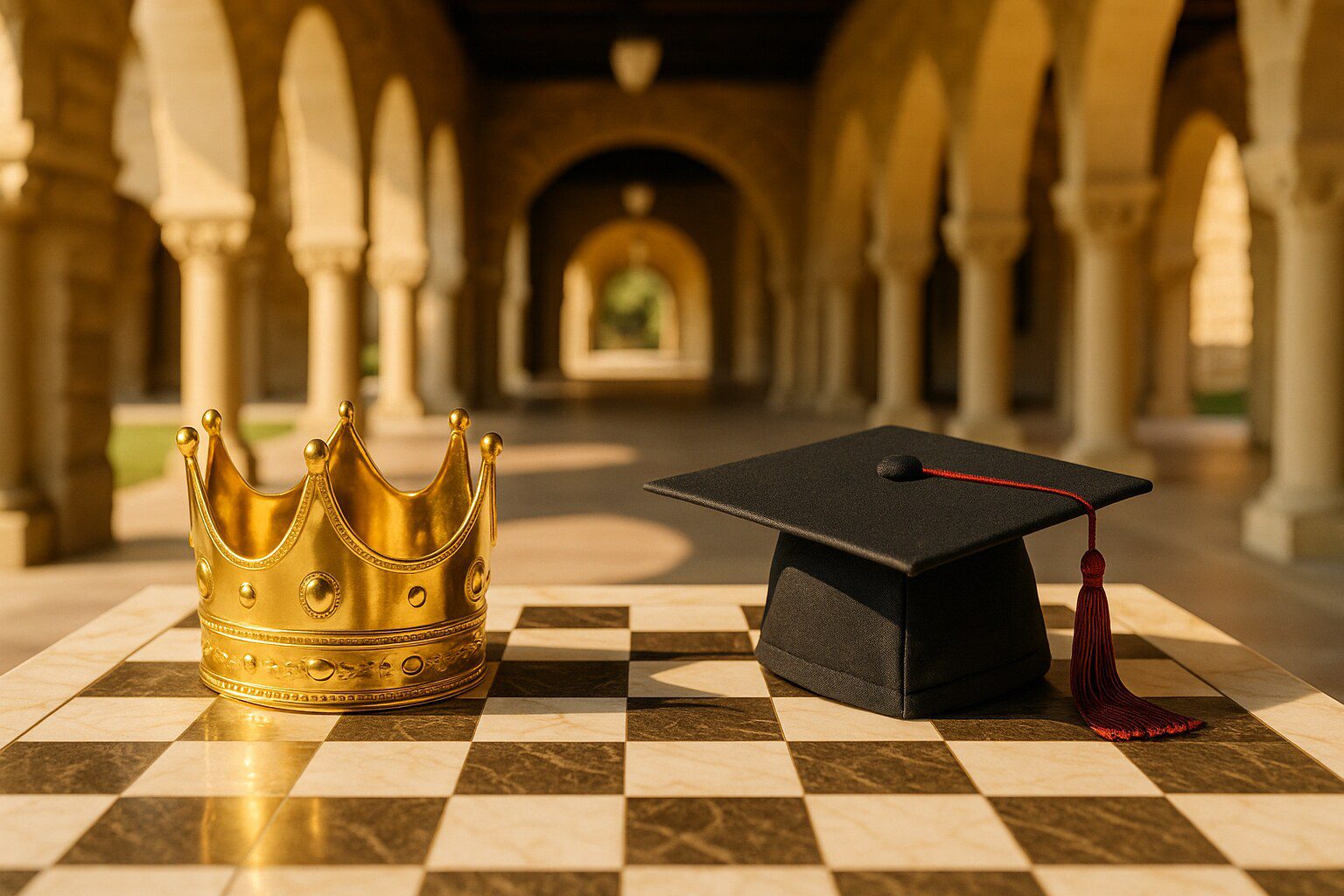
What a Seventeen-Year-Old Freshman, a Federal Docket, and a Football Game Have to Say About Stanford University
Published by NoEthicsInBigTech.com · ForeverPeaceNow.com
By Vahid Razavi
Author, No Ethics in Big Tech (2026) and Ethics in Tech and Lack Thereof (2018) | Director, Forever Peace Now | September 8, 2026
Notice to the Reader
This is a long-form essay published on NoEthicsInBigTech.com and ForeverPeaceNow.com. It draws on three sources: the No Ethics in Big Tech Fact Sheet About Stanford University, which I prepared for publication on this site; the book How to Rule the World: An Education in Power at Stanford University by Theo Baker (Penguin Press, May 19, 2026), which I discuss here through the public record and published reviews; and my own two books and documentary. Every factual claim is sourced and linked in the Sources section. Passages marked as satire are satire. Everything else is documented.
I. Two Educations at Stanford
I owe Stanford University something, and I want to say so before I say anything else.
After the machine broke me — after a government contractor with billions in federal money sued my cloud startup for using my own trademark, after the bankruptcy I filed from a hospital bed — Stanford University Hospital, San Francisco General, and Laguna Honda gave me four and a half months of the best care a human being could ask for. I walked out with a cane and a decision: if I was going to keep going, I would go inside the biggest cloud company on earth and understand it from the inside. I did. I worked at Amazon Web Services. I wrote briefing documents for Andy Jassy. I attended partner meetings with him. And then I spent the next decade documenting what I learned.
So I know two Stanfords. There is the Stanford of the nurses and the physical therapists who put a broken man back together for no reason other than that it was their job and they were good at it. And there is the other Stanford — the one that trains the people who build the machines that break people.
In May of this year, a 21-year-old named Theo Baker published a book about the second Stanford. He arrived on campus in the fall of 2022 at seventeen, a coder who wanted to build things. He left in June 2026 with degrees in History and Computer Science, a George Polk Award — the youngest recipient in the award’s history — and a New York Times bestseller titled How to Rule the World: An Education in Power at Stanford University. Warner Bros. and producer Amy Pascal bought the film rights before he had finished his junior year.
I have spent thirty years in this industry. I raised money from Marc Benioff and Michael Dell. I sat across the table from serious money at twenty-two. It took me until my forties, and a hospital, to see clearly what Theo Baker saw in his first year at Stanford. That is not a criticism of me. It is an indictment of how well the machine hides itself from the people inside it — and how visible it becomes when a teenager with a notebook simply writes down what the adults say when they think the room is friendly.
This essay puts his book next to our fact sheet and next to two things I am building. The picture that emerges is not complicated. It is just uncomfortable.
II. What the Freshman Found
The public record of Baker’s book — the publisher’s description, the reviews in The New York Times, Slate, the San Francisco Chronicle, the Los Angeles Review of Books, Washington Monthly, and The Times of London — describes a campus with two layers. There is Stanford, the university. And there is what Baker calls the Stanford within Stanford: an inner enclave of students who intend to become the next Zuckerberg, and the adults who cluster around them to get a piece of the action before the action starts.
According to Slate’s review, the mechanics of that enclave are as follows. Venture capitalists prowl campus for talent and shower undergraduates with no-strings-attached cash. There is a term, “pre-idea funding,” for money given to teenagers who might someday have an idea. There is a student hackathon club, TreeHacks, that reportedly receives more venture money than it knows what to do with and holds its parties on yachts and at resorts. There is a coffee shop where scouts and investors meet promising students. And there is an informal, invitation-only seminar — the one the book is named after — run by a mentor figure intent on cultivating the cream of the STEM undergraduates. The class is literally called How to Rule the World.
Baker’s own summary of what that world made of him is four words long. He writes, per Slate’s excerpt of the book, that “Teenagers like me were a commodity.”
And then there is what the commodities told him. Slate reports that Baker’s classmates and acquaintances in the tech world admitted to him — to a student reporter — conduct that included tax fraud, research misconduct, embezzlement, securities fraud, insider trading, running slush funds and shell companies, hacking, and helping foreign dictators. Billionaires came to campus and gave speeches saying that roughly a hundred and fifty men run the world, that politicians are puppets, and that the point of success is to accumulate enough of the world’s capital to redirect it toward your own worldview.
Whatever these men say on a stage at Davos about changing the world, in the inner rooms at Stanford, according to the freshman who was sitting in them, they say what they actually want. Power. And it is at Stanford that the wanting is taught.
I have been saying a version of this since 2018. Ethics in Tech and Lack Thereof was a book about the gap between what these companies say and what they do. No Ethics in Big Tech, published this August on Hiroshima Day, is a book about what happens when you stop expecting the gap to close. Theo Baker’s contribution is that he got the confession on the record before the confessors had learned to stop talking.
III. The President
The reason anyone outside the Stanford Daily knows Theo Baker’s name is what he did next.
In November 2022, as a freshman, Baker began publishing stories in the student newspaper about allegations that Marc Tessier-Lavigne — the president of Stanford University, a celebrated neuroscientist, the former chief scientific officer of Genentech — was an author on research papers containing manipulated images. Stanford appointed an independent panel led by a former federal judge. The panel reviewed twelve papers and more than fifty thousand documents.
On July 19, 2023, the panel’s report was released and Tessier-Lavigne announced his resignation, effective August 31. The findings deserve to be stated precisely, because precision is the whole point of this project. The panel concluded that Tessier-Lavigne did not personally engage in research misconduct. It also found manipulation of research data in papers from labs he ran, at different institutions and at different times, and that he had repeatedly failed to decisively correct the scientific record once problems were flagged. He agreed to retract three papers and correct two others. He remains on the Stanford faculty as a professor of biology.
Nine months later, in April 2024, Tessier-Lavigne became chief executive of a new artificial-intelligence drug-discovery company called Xaira Therapeutics. It launched with one billion dollars in committed capital from some of the largest venture firms in Silicon Valley.
The student who found the problem won a Polk Award and a book contract. The president who presided over it resigned into a billion-dollar startup. I do not say this to diminish either outcome. I say it because it is the cleanest illustration in the entire record of how the Stanford ecosystem processes a scandal: everybody gets promoted.
IV. Where the Book Meets the Docket
Theo Baker wrote about what Stanford teaches. Our fact sheet documents what its graduates and non-graduates went on to do. Read together, they are cause and effect.
A few entries from the fact sheet, each sourced to a court record, a federal agency, a signed filing, or the subject’s own words:
-
Elizabeth Holmes, chemical engineering, left 2003. Convicted January 3, 2022, of conspiracy and three counts of wire fraud. Sentenced to 135 months. Her Stanford professor, Channing Robertson, became Theranos’s first board member and testified under oath in 2016 that the company paid him $500,000 a year for roughly ten hours a month. Holmes went to prison. He went back to teaching.
-
Do Kwon, computer science, class of 2015. Pleaded guilty in August 2025; sentenced December 11, 2025, to fifteen years for a fraud the judge described as generational in scale. Ten years from commencement to fifteen years in custody.
-
Carlos Watson, economics, 1991. Convicted at trial in July 2024 of securities fraud, wire fraud, and aggravated identity theft. Sentenced to 116 months. Ordered to repay roughly $96 million. Commuted by the President on March 28, 2025, hours before he was due to surrender. Served zero days. Restitution extinguished.
-
Larry Page and Sergey Brin, computer science PhD candidates on leave since 1998. Their company was ruled an illegal monopolist under Section 2 of the Sherman Act on August 5, 2024, with remedies ordered September 2, 2025. The search technology was developed at Stanford, patented by Stanford, and licensed to Google in exchange for 1.8 million shares — which the university sold in 2005 for $336 million. Stanford’s own president, John Hennessy, sat on Google’s board of directors, a relationship Google disclosed in its own proxy statements.
-
Peter Thiel, BA 1989, JD 1992, and Alexander Karp, JD 1992. Together they founded Palantir. Thiel wrote in 2009, in an essay published by the Cato Institute, that he no longer believed freedom and democracy were compatible. Palantir’s $30 million ICE contract to build a deportation logistics platform called ImmigrationOS was awarded in April 2025.
-
Sam Altman, computer science, left 2005. Removed by OpenAI’s board on November 17, 2023, for not being consistently candid with it. Reinstated five days later after the board itself was removed. The governance structure built to keep artificial general intelligence accountable to humanity lasted four days under pressure.
-
Reid Hoffman, BS 1990. Apologized in 2019 for his role in fundraising activities involving Jeffrey Epstein and said his last contact was in 2015. On February 4, 2026, he publicly disclosed six additional meetings, in 2016 and 2018, that he had not previously acknowledged. Every one of them took place after Epstein’s 2008 conviction.
That is not a rogues’ gallery assembled from a grudge. It is a placement record. Baker describes the recruiting pipeline. The docket describes the graduates. What sits between them — the thing that converts a talented seventeen-year-old into a defendant, a monopolist, or a man who thinks democracy is optional — is the subject of the next section.
V. The Disease Has a Name: Greed Learning
At GreedLearning.com — a ForeverPeaceNow initiative launched this year in alliance with EthicsInTech.com, ParentsPlea.com, AgeOfNepotism.com and NoEthicsInBigTech.com — we gave the thing a name. Greed learning is education stripped of conscience. It is the reorganization of every level of schooling, from high school to the doctoral program, around a single question: how much money can this knowledge extract, and for whom?
The site describes what it looks like, and every description reads like a chapter summary of Baker’s book. A brilliant young woman who wanted to cure disease is told the smart move is optimizing ad-click algorithms. A high school senior is told that nursing or teaching or ecology is a waste of his potential, but training the models that will eliminate forty million office jobs is changing the world. Universities take hundreds of millions from AI vendors and then wonder why their ethics departments shrink while their machine-learning labs are gilded. Government agencies that should regulate the vendors recruit from them, defer to them, and retire into them — the revolving door I documented in Chapter Seven of No Ethics in Big Tech and that AgeOfNepotism.com tracks by name.
Greed learning is not learning at all. It is training. A dog is trained. A falcon is trained. A human being is educated — and education, in every civilization that ever flourished, meant the formation of character and conscience alongside knowledge.
The stakes are not abstract. The stated ambition of a handful of AI vendors — four or five corporations backed by the largest concentrations of capital in human history — is artificial general intelligence: systems that perform the cognitive labor currently done by people. Their own investors describe the prize as the global wage base for knowledge work, on the order of thirty to forty trillion dollars a year. Their business plan is your job. Their addressable market is your parents’ livelihood. And the machine cannot be built without a continuous harvest of young minds recruited from exactly the campuses Theo Baker describes.
This is why the book matters beyond Palo Alto. The “How to Rule the World” seminar is not a Stanford eccentricity. It is the honest name for what the pre-idea funding and the yacht parties and the recruiter at the coffee shop are for. The rest of the industry just uses a euphemism.
VI. The Human Condition, Stated Plainly
There is a philosophical framing I have carried through all of this work, and it is the only theory in this essay. The real struggle humanity is facing — beneath the technology, beneath the weapons, beneath the arguments about East and West — is between two ideas. The first is I am one. The second is We are one.
Everything in Baker’s book is a monument to the first idea. A hundred and fifty men run the world. Teenagers are a commodity. Success is aggregating capital to impose your worldview. I am one; my cap table is one; my exit is one.
Everything greed learning produces is the first idea at industrial scale. Every wisdom tradition on earth placed greed among the gravest corruptions of the human heart — not because wealth is evil, but because greed reorders love. It teaches you to love things and use people, when a moral life requires you to love people and use things. Greed learning completes that inversion for an entire generation at once. It takes the most gifted minds of the age and teaches them to see the rest of humanity as a payroll line to be automated away.
And the tragedy — the part that should keep every parent awake — is the timing. The machine gets there first. The venture scout meets the seventeen-year-old before the seventeen-year-old has any idea what the world outside the coffee shop looks like. This is the same sequence I documented in Chapter Seventeen of my book about military recruiting: the Army’s e-sports teams and Twitch streams reach a young man before he has seen what war does to a body. The recruiter for the machine and the recruiter for the war are running the same play. Get them before they know.
VII. What We Build Instead
Documentation without an alternative is just despair with footnotes. So here is the alternative, in two parts.
For the student: a pledge
GreedLearning.com hosts a public pledge for high school, college, and graduate students. It is six commitments, signed in the open. In summary: I will not devote my studies or labor to building systems whose purpose is replacing human workers for shareholder enrichment. I will ask of every course, internship, and job offer who it serves and who it harms. I will bring my conscience into the classroom and the workplace and not check it at the recruiter’s door. I will use my talents for healing, teaching, building, defending, feeding, and truth-telling. I will stand with classmates who refuse. And I will call on my school and my government to regulate AGI and refuse funding that buys silence. Your name, school, and reason are the only things published. Chapters can be started at any school.
For the young person who wants to understand war: ConflictTour
ConflictTour.com is a planned six-month structured humanitarian service program — an alternative to military enlistment. Two tracks. The Local Service Track keeps participants in their home country, matched with refugee families and war-affected communities: helping with asylum and benefits applications, translating at medical appointments, documenting testimony for legal advocacy, reducing isolation. It launches in January 2027. The International Track sends participants to former war zones currently deemed safe by international travel advisories, to document the impact of war on civilian infrastructure and interview survivors for legal and historical archives. It is expected to launch in September 2027. Both begin with two months of training in trauma-informed communication, legal documentation, and — critically — self-care for the person doing the witnessing. Participants take a five-part pledge before they start. The program is honest about its limits: it provides no insurance, no evacuation, no extraction. Participants are adults who accept responsibility for their own safety. Upon completion they receive a Certification in Humanitarian Witness.
The military-industrial complex offers a young person a weapon. Stanford, according to the freshman who was there, offers a young person a cap table. ConflictTour offers a notebook, a camera, and a seat beside a family rebuilding its life. This is service with no uniform. This is courage with no rifle. And a person who has spent six months at that kitchen table makes a different decision at the recruiting office — or the coffee shop — than one who has not. Not necessarily the same decision. An informed one.
VIII. What We Are Asking of Stanford
Our fact sheet closes with specific asks, and I repeat them here because Baker’s book makes each one harder to refuse:
-
Publish the faculty conflict-of-interest file on the Theranos matter, and state whether any review of Channing Robertson’s board compensation was ever conducted.
-
Disclose annually the university’s equity positions in companies founded by current students, recent alumni, or sitting faculty, and the ethics review applied to those positions. If you are the supply chain, say so.
-
Make ethics a graduation requirement with teeth — a required, graded, case-based sequence taught by faculty with no financial interest in the industry, using these cases.
-
Teach the law your graduates will be prosecuted under. Europe has moved toward personal criminal liability for executives whose companies destroy environments and enable atrocities. Stanford should teach it, not just lobby against it.
-
Stop honoring the convicted and the credibly implicated. Buildings, fellowships, and podiums are endorsements.
And one more, prompted by the book: disclose the money. Who funds the student clubs. Who pays for the yachts. Which venture firms have standing access to undergraduates, on what terms, with what disclosures to their parents. If it is all above board, it will survive being written down.
IX. On the Matter of Trees
SATIRE BEGINS. Stanford University has not endorsed any of the following.
Stanford’s unofficial mascot is a tree. Theo Baker’s hackathon club is named for it. This has always seemed to me like unusually honest branding for an institution that specializes in growing things slowly, in perfect conditions, on land it does not pay property tax on, and then acting surprised when the fruit turns out the way it does.
Trees have a natural predator. On November 22, 2025, Stanford beat California 31–10 and took the Axe back after four years in Berkeley. Two Cal fumbles were returned for touchdowns. It was not our finest afternoon.
The 129th Big Game is Saturday, November 21, 2026, at California Memorial Stadium in Berkeley. Both programs will arrive with first-year head coaches. I make no prediction. I only observe that the University of California — a public institution, funded by the taxpayers, open to the people of this state — has a long and honorable tradition of taking a blade to that particular grove. And that this year, more than most, there would be something fitting about a book called How to Rule the World being followed, six months later, by an afternoon on which the world declined to be ruled.
Go Bears. Chop responsibly.
SATIRE ENDS.
X. The Last Word
I have seen enough. I saw it at eleven in a Tehran hospital corridor beside my mother the nurse. I saw it at twenty-two in a conference room with people whose names you know. I saw it at Amazon. And a seventeen-year-old saw it at Stanford in his first year, wrote it down, and won the most serious award in his profession for doing so.
Evil men and their machines do not prevail. But they do not stop on their own. The arc of history bends because people push it. Theo Baker pushed. This essay is my push. The pledge and the notebook are yours.
Witness. Serve. Choose Peace.
XI. Sources
Every link below was retrieved and verified on September 8, 2026. Primary sources — court records, DOJ releases, federal filings, the subjects’ own statements — are prioritized over secondary reporting.
How to Rule the World — Theo Baker
Penguin Random House — official book page (Penguin Press, ISBN 9780593832837) — https://www.penguinrandomhouse.com/books/760317/how-to-rule-the-world-by-theo-baker/
Author site — publication date May 19, 2026 — https://theobaker.info/book
Wikipedia — How to Rule the World (reviews, film rights, publication history) — https://en.wikipedia.org/wiki/How_to_Rule_the_World
Wikipedia — Theo Baker (biography; graduated June 2026, History and Computer Science) — https://en.wikipedia.org/wiki/Theo_Baker
Stanford Department of History — Class of 2026 graduates list — https://history.stanford.edu/about/congratulations-stanford-history-class-2026
Slate — Laura Miller review, May 27, 2026 (the Stanford within Stanford; pre-idea funding; TreeHacks; the seminar; confessions; billionaire speeches) — https://slate.com/culture/2026/05/stanford-university-theo-baker-how-to-rule-the-world-book-marc-tessier-lavigne-silicon-valley-tech-vc.html
The New York Times — Anand Giridharadas review, May 18, 2026 — https://www.nytimes.com/2026/05/18/books/review/theo-baker-how-to-rule-the-world.html
Los Angeles Review of Books — Arjun Appadurai review, June 20, 2026 — https://lareviewofbooks.org/article/rule-world-education-power-stanford-tech-theo-baker/
Washington Monthly — Alex Bronzini-Vender review (critical), May 19, 2026 — https://washingtonmonthly.com/2026/05/19/fear-and-loathing-in-palo-alto/
San Francisco Chronicle — Lily Janiak review, May 18, 2026 — https://www.sfchronicle.com/entertainment/books/article/theo-baker-stanford-memoir-22248176.php
ABC7 San Francisco — interview, May 28, 2026 — https://abc7news.com/post/how-rule-world-stanford-student-journalist-theo-baker-releases-book-reporting-leads-ousting-former-president/19183789/
Deadline — Warner Bros. / Amy Pascal film rights, Nov. 3, 2023 — https://deadline.com/2023/11/amy-pascal-movie-stanford-president-research-scandal-resignation-1235590262/
Marc Tessier-Lavigne
The Stanford Daily — resignation and retractions, July 19, 2023 — https://stanforddaily.com/2023/07/19/stanford-president-resigns-over-manipulated-research-will-retract-at-least-3-papers/
STAT News — panel findings in detail, July 19, 2023 — https://www.statnews.com/2023/07/19/marc-tessier-lavigne-stanford-president-resignation/
Palo Alto Online — panel led by former federal judge Mark Filip; 50,000+ documents — https://www.paloaltoonline.com/news/2023/07/19/stanford-president-resigns-after-review-of-his-research-papers/
Bloomberg — Xaira Therapeutics launches with $1 billion, April 23, 2024 — https://www.bloomberg.com/news/articles/2024-04-23/ex-stanford-president-tessier-lavigne-s-ai-drug-startup-pulls-in-1-billion
Wikipedia — Marc Tessier-Lavigne (current Stanford biology professor; Xaira CEO) — https://en.wikipedia.org/wiki/Marc_Tessier-Lavigne
Fact Sheet Entries Cited in Section IV
U.S. DOJ — Holmes sentenced to 135 months, Nov. 18, 2022 — https://www.justice.gov/usao-ndca/pr/elizabeth-holmes-sentenced-more-11-years-defrauding-theranos-investors-hundreds
ABC News — Channing Robertson paid $500,000/year (sworn testimony) — https://abcnews.com/Business/theranos-remarkable-blood-test-claims-began-unravel/story?id=61173853
U.S. DOJ, SDNY — Do Kwon sentenced to 15 years, Dec. 11, 2025 — https://www.justice.gov/usao-sdny/pr/crypto-enabled-fraudster-sentenced-orchestrating-40-billion-fraud
NBC News — Carlos Watson sentence commuted, March 28, 2025 — https://www.nbcnews.com/business/business-news/trump-commutes-sentence-ozy-media-founder-carlos-watson-rcna198667
NPR — Google remedies ruling, Sept. 2, 2025 — https://www.npr.org/2025/09/02/nx-s1-5478625/google-chrome-doj-antitrust-ruling
Redorbit / San Jose Mercury News — Stanford earns $336 million from Google stock, 2005 — https://www.redorbit.com/news/education/318480/stanford_earns_336_million_off_google_stock/
SEC — Google 2013 proxy statement disclosing Stanford President John Hennessy on Google’s board and Stanford patent license — https://www.sec.gov/Archives/edgar/data/0001288776/000130817913000248/lgoogle_def14a.htm
Cato Unbound — Peter Thiel, “The Education of a Libertarian,” April 13, 2009 — https://www.cato-unbound.org/2009/04/13/peter-thiel/education-libertarian/
Axios — ICE awards Palantir $30 million for ImmigrationOS, 2025 — https://www.axios.com/local/denver/2025/05/01/palantir-deportations-ice-immigration-trump
CNBC — Helen Toner on why OpenAI’s board removed Altman — https://www.cnbc.com/2024/05/29/former-openai-board-member-explains-why-ceo-sam-altman-was-fired.html
Axios — Reid Hoffman apology, Sept. 12, 2019 — https://axios.com/2019/09/12/reid-hoffman-jeffrey-epstein-mit-donations
Reid Hoffman on X — Feb. 4, 2026 disclosure of six additional meetings — https://x.com/reidhoffman/status/2018868269512343670
The Big Game
Stanford Athletics — 2026 schedule; 129th Big Game at California, Nov. 21, 2026 — https://gostanford.com/news/2026/1/26/complete-2026-schedule-unveiled
Cal Athletics — 2026 schedule; Big Game at Memorial Stadium, Nov. 21, 2026 — https://calbears.com/news/2026/1/26/california-football-announces-2026-schedule.aspx
Stanford Athletics — Stanford 31, California 10, Nov. 22, 2025 — https://gostanford.com/news/2025/11/22/stanford-dominates-california-to-take-back-the-axe-31-10
Related Work by the Author
No Ethics in Big Tech — Fact Sheets (living document) — https://noethicsinbigtech.com/facts/
No Ethics in Big Tech — the book — https://noethicsinbigtech.com/book/
GreedLearning.com — What is greed learning? — https://greedlearning.com/what-is-greed-learning
GreedLearning.com — The billionaires’ AGI plan — https://greedlearning.com/the-agi-plan
GreedLearning.com — The student pledge — https://greedlearning.com/pledge
ConflictTour.com — program overview, two tracks, pledge, risk acknowledgment — https://conflicttour.com
Forever Peace Now (documentary) — https://foreverpeacenow.com
My AWS Story — https://myawsstory.com
Ethics in Tech — https://ethicsintech.com
Age of Nepotism — the revolving door, by name — https://ageofnepotism.com
XII. Editorial Notes
-
I have not reproduced passages from Mr. Baker’s book. The account of its contents here is drawn from the publisher’s description and from published reviews, each linked above, and one four-word quotation reproduced in Slate’s review is used for purposes of commentary. Readers should buy the book. It is worth the money, which is more than I say about most things produced within a mile of Palo Alto.
-
The Tessier-Lavigne findings are stated exactly as the panel stated them: no personal misconduct; manipulation of data by others in his labs; failure to correct the record. Readers who see this summarized elsewhere as “the president committed fraud” should treat that summary as inaccurate.
-
Washington Monthly’s review argues that Baker’s disdain for his subjects sometimes turns them into straw men. That criticism is linked above. I include it because a project that demands the other side show its sources should show the reviews it would rather you did not read.
-
ConflictTour is at the idea and planning stage. It is not incorporated, has no revenue, has no investors, and pays no one. GreedLearning.com is free and carries no advertising. Neither will ever be a cash cow, and this essay makes me no money.
Research Credit
Research assistance, source verification, fact-checking, and drafting support for this document were provided by Claude, the AI assistant developed by Anthropic. Every citation was independently retrieved and verified against primary sources during preparation on September 8, 2026. Where a claim could not be verified against a primary source, it was removed rather than published.
As I have written elsewhere: I justify using the power of AI to do good. To the benefit of humanity. A fool with a tool is still a fool — but a researcher with a tool that checks its own citations is faster than a propaganda department with a budget.
Legal Disclaimer
This document is published for educational, journalistic, and public-interest purposes. It constitutes commentary, criticism, satire, and reporting on matters of legitimate public concern regarding public figures and public institutions. It is protected expression under the First Amendment to the Constitution of the United States, under Article 20 of the Spanish Constitution, and under equivalent free-expression protections in other jurisdictions where it may be read.
Statements of fact are sourced and linked. Statements of opinion are identified as such. Satirical passages are explicitly marked and are not assertions of fact. Allegations that have not been adjudicated are identified as allegations, and denials are noted where they have been made publicly. Quotations from books and reviews are brief and used for purposes of criticism and commentary.
This document does not constitute legal advice. Attorneys, journalists, policymakers, prospective employees, and prospective business partners are encouraged to consult the primary sources linked in the Sources section rather than relying on this summary. Corrections may be submitted through NoEthicsInBigTech.com. Verified corrections will be published.
© 2026 Vahid Razavi. Licensed under Creative Commons Attribution-NonCommercial-NoDerivatives 4.0 International (CC BY-NC-ND 4.0).