From Mushroom Cloud to Cloud Computing — Big Tech’s Eternal War on Humanity
ForeverPeaceNow.com — July 4, 2026
Two hundred and fifty years ago today, a group of people declared that power exercised without consent, without accountability, and without conscience was illegitimate — no matter how powerful the hand that held it. That is the whole American idea, stripped to its core: that no one is above the reckoning of law, and that the people have both the right and the duty to demand accountability from those who rule them.
I am marking that anniversary by announcing a book about the people in our own time who have decided the idea does not apply to them.
On August 6, 2026 — the 81st anniversary of the bombing of Hiroshima and Nagasaki — I will publish No Ethics in Big Tech: An Insider’s Case Against Silicon Valley’s War on Humanity, and the Fight to Make Them Pay.
I did not choose these two dates by accident. One is a promise a nation made about liberty and accountability. The other is the day humanity first proved it could build a technology capable of ending itself. This book lives in the distance between those two dates — between what we said we would be, and what our most powerful industry is actually building.
This is not a book about technology
It is a book about power — who holds it, what they do with it, and what happens to everyone else when no one holds them to account.
I spent three decades inside Silicon Valley. I founded startups. I was a Senior Alliances Manager at Amazon Web Services. I sat in the rooms where these decisions took shape, and I watched an industry that once held genuine creative promise become, honestly, a machine for concentrating power and exporting violence. I left. I documented what I saw. And I built the organizations — Ethics in Technology, No Ethics in Big Tech, ParentsPlea.com, the petition to the Spanish government — that this book chronicles and extends.
This is not a theoretical argument. It is a sourced, chapter-by-chapter accounting: named executives, documented contracts, verified dollar amounts, and the real human beings — workers, families, journalists, children — who paid the price for decisions made in boardrooms that could look at mass death and call it, in their own words, a “golden opportunity.”
The human rights case at the core
At the center of the book is one documented fact: the $1.2 billion Project Nimbus contract between Amazon, Google, and the Israeli government and military supplied cloud computing and AI infrastructure to systems — including the ones reported as Gospel and Lavender — used to flag people as targets on a scale, and with an error rate, that no one who values human life should be able to accept. Four hundred engineers at Amazon and Google tried to stop it. The companies filmed the protests, identified the participants, and fired them.
That is not a metaphor. In the book I argue it is the business model — and I trace how it connects to everything else the record documents: a Palantir manifesto that treats endless war as civilization’s highest calling; Oracle executives building propaganda tools and calling it volunteer work; Meta content-moderation workers in Nairobi shown footage captured without consent, then fired with days’ notice for saying so; Amazon warehouse workers injured at multiples of the industry average while the company posts record profits; and journalists, activists, and human rights organizations silenced across the major platforms as evidence of possible war crimes was scrubbed at a foreign government’s request.
The book names the people responsible. It cites the sources. It builds the evidentiary record.
Why the AI dimension is the central warning
Here is where the two anniversaries meet.
The same companies supplying the targeting infrastructure for military operations today are, at the same time, racing toward artificial-intelligence capabilities their own technical teams describe as a possible watershed in human history — and they are doing it without international governance, without binding oversight, without anything resembling a Nuclear Non-Proliferation Treaty for AI. Anthropic’s own researchers have described a narrow window — on the order of six to eighteen months — before the next generation of capabilities proliferates beyond the handful of organizations now developing them. That window is closing. The guardrails are not being built.
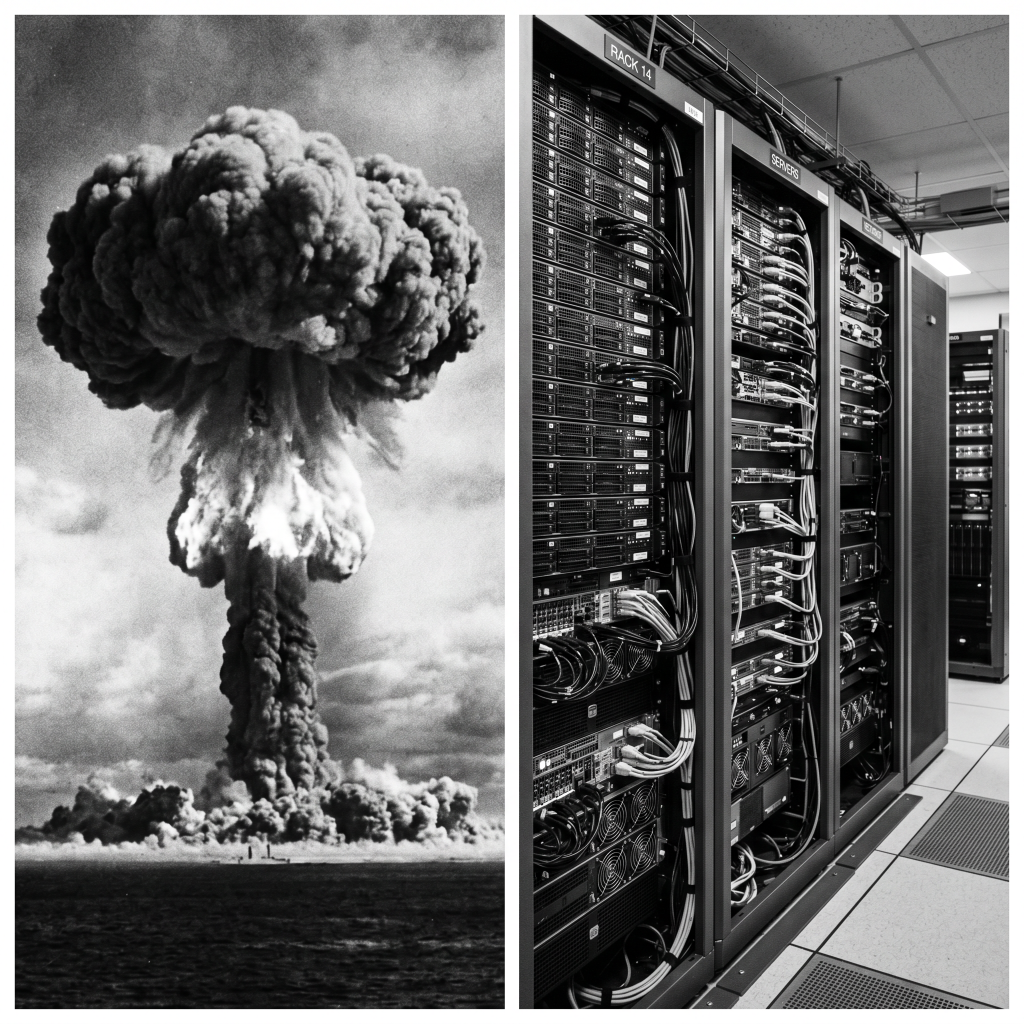
In 1945 we learned that a technology can outrun our wisdom in the space of a single morning. The mushroom cloud was the twentieth century’s warning. Cloud computing — in the hands of men who have no red lines, funded by capital that has no conscience, operating inside a regulatory environment they spent fortunes designing in their own favor — is the twenty-first’s.
I do not argue that technology is evil. I argue, with evidence, that technology placed in those hands, without accountability, is existentially dangerous. Not as abstraction. As current, documented, provable fact.
The video: From Mushroom Cloud to Cloud Computing
On August 6th, alongside the book, I’ll release a short film for social media — From Mushroom Cloud to Cloud Computing: Big Tech’s Eternal War on Humanity. It draws the line the book draws, in a few minutes, for anyone who needs to see it before they read it. Watch for it here and across the ForeverPeaceNow and No Ethics in Big Tech sites on the anniversary.
What this book asks of you
No Ethics in Big Tech ends with action, not despair. It documents:
- The petition to the Spanish government, calling on prosecutors with established universal jurisdiction to open criminal investigations into named executives at Amazon, Google, Oracle, Microsoft, Palantir, and their affiliates.
- The European regulatory revolt already underway.
- ParentsPlea.com — a memorial database documenting the victims of the assault on Gaza, one profile at a time, so the algorithm cannot erase what the weapons produced.
- ConflictTour — an alternative to military recruitment that offers young people the chance to bear witness to the consequences of war rather than be trained to produce them.
The single request underneath all of it: treat these companies not as corporations that made policy errors, but as institutions that made deliberate choices with documented consequences for human life — and demand they be held accountable in courts of law, not only in the court of public opinion.
On this day, of all days
There is something fitting about launching this on the Fourth of July. The founders’ quarrel was never really with a place. It was with the idea that power could put itself beyond accountability. Two hundred and fifty years later, that quarrel is not over. It has only changed its address — from a throne to a boardroom, from a crown to a cloud contract.
The record is built. The evidence is documented. The names are named. What happens next depends on who reads this book — and what they decide to do with it.
Evil men and their machines do not prevail on their own. History is long, and it is littered with their kind. But the arc bends only because people push it. This Independence Day, I am asking you to push yours.
Live in peace. Not just rest in peace.
No Ethics in Big Tech by Vahid Razavi publishes August 6, 2026 — the 81st anniversary of Hiroshima and Nagasaki.
Vahid Razavi is the founder of No Ethics in Big Tech, Ethics in Technology, ParentsPlea.com, and GoAmour.com. He is the author of The Age of Nepotism and Ethics in Tech and Lack Thereof. No Ethics In Big Tech will be his third book. | View His Documentary ForeverPeaceNow.com